Front Post and Back Post Double Crochet: Ribbing and Texture
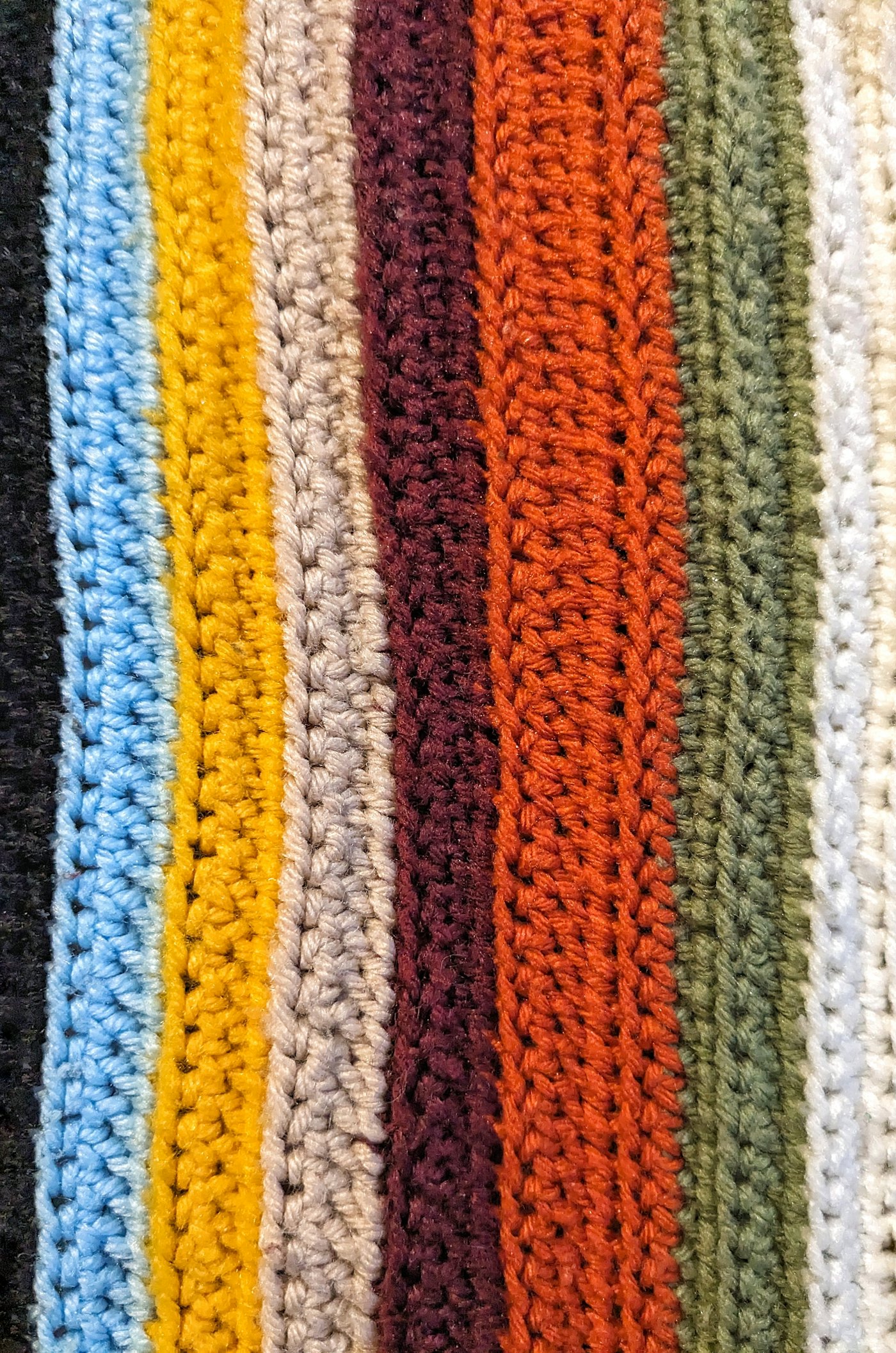
Post stitches are worked around the post of a stitch instead of into its top loops. They push stitches forward or back, creating ribbing, cables and basketweave. If you can double crochet, you already know 90% of it.
4 min readPublished Updated
This profile is a development placeholder, not a real person, and claims no credentials. See our contributors.
The short version
- A post stitch is worked around the vertical body of a stitch, not into its top.
- Front post (FPdc) sits forward on the side facing you; back post (BPdc) sits back.
- Alternating FPdc and BPdc makes a stretchy rib that looks like knitted ribbing.
- Post stitches use more yarn and make thicker fabric than regular stitches.
What "post" means
Every stitch has a top, the two loops you usually work into, and a post: the vertical body of the stitch underneath. Post stitches are worked around that post instead of into the top loops.
Going around the post from the front pushes the new stitch toward you. Going around from the back pushes it away. Alternate them and you get raised columns, like knitted ribbing.
| Abbreviation | Meaning |
|---|---|
| FPdc | Front post double crochet |
| BPdc | Back post double crochet |
| FPsc / BPsc | Front / back post single crochet |
| FPtr / BPtr | Front / back post treble crochet |
These are the standard Craft Yarn Council abbreviations, so you'll see the same ones in most US patterns.
Front post double crochet (FPdc), step by step
You need at least one row of regular stitches to work around first. A row of double crochet is ideal.
- 1.Yarn over.
- 2.Insert the hook from front to back in the space to the right of the post, then bring it back to the front in the space to the left of it. The post is now lying across the front of your hook. (Left-handers: mirror these directions.)
- 3.Yarn over and pull up a loop around the post. You have 3 loops on the hook.
- 4.Yarn over and pull through 2 loops, then yarn over and pull through the last 2.
The new stitch sits proudly in front of the fabric.
Back post double crochet (BPdc), step by step
- 1.Yarn over.
- 2.Insert the hook from back to front in the space to the right of the post, then back through to the back on the left side. Now the post lies behind your hook.
- 3.Yarn over and pull up a loop around the post. You have 3 loops on the hook.
- 4.Finish like a double crochet: yarn over, pull through 2, yarn over, pull through 2.
On the side facing you, a back post stitch recedes. On the other side of the fabric it looks like a front post stitch, which is why ribbing looks the same on both sides.
Making crochet ribbing
The classic use is a stretchy rib for hat brims, cuffs and sweater hems.
- 1.Work a foundation row of double crochet with an even number of stitches.
- 2.Rib row: ch 2 (doesn't count as a stitch), then
*FPdc around next st, BPdc around next st; rep from * across, turn. - 3.Following rows: look at the stitches facing you. Work a FPdc around every stitch that pops toward you, and a BPdc around every stitch that sits away from you.
That last rule is the secret: you always "knit the knits and purl the purls," as knitters say. If you follow what you see rather than counting, the ribs stay in neat columns even when you lose your place.
For a two-by-two rib, work two FPdc and two BPdc, using a multiple of 4 stitches.
Counting post stitches
Each post stitch counts as one stitch and replaces the stitch it's worked around. When you work a post stitch, skip the top of that stitch in the row you're on. Otherwise you'll add a stitch every time.
Some patterns start or end post-stitch rows with a regular double crochet in the first and last stitch, to keep the edges straight. If your pattern does this, follow it. It gives a much neater edge than a post stitch around the turning chain.
What to expect from post-stitch fabric
- It's thicker and warmer, because stitches overlap. Ideal for winter hats and blankets.
- It uses more yarn than the same area of plain double crochet, because each stitch wraps around another. Buy extra yarn for a post-stitch blanket. Our yarn calculator lets you allow for denser textured stitches.
- It's slightly shorter per row, since post stitches pull down a little. Work a gauge swatch if size matters.
- It's stretchier widthwise when ribbed, which is exactly why it's used for brims.
Once ribbing feels easy, the same two stitches make basketweave (blocks of FPdc and BPdc that swap every few rows) and simple cables (post stitches worked out of order so they cross).
Questions crocheters ask
Front post goes around the stitch from the front, so it sits forward. Back post goes around from the back, so it sits back. Alternating them makes ribbing.
Related Crochet Calculators & Converters
Yarn Calculator
Estimate total yardage, meters, and skein count needed for blankets, scarves, sweaters, and shawls.
Stitch Count Calculator
Calculate the exact number of stitches needed to resize any pattern or match custom dimensions.
Crochet Hat Size Calculator
Calculate crown circle diameter, total hat height, and stitches for preemie to adult sizes.
Related Educational Guides & Tutorials
What Is Crochet Gauge? How to Measure It and Why It Matters
Gauge is the translation key between the designer's hands and yours. Learn how to make a swatch that tells the truth, measure it, match the pattern, and use the math to size any project.
How to Read a Crochet Pattern: The Complete Guide
Every part of a crochet pattern explained, from skill levels and multiple sizes to repeats, stitch counts, shaping language, charts and schematics, plus what to do when something seems wrong.