How to Double Crochet (dc) and Avoid Gappy Edges
Double crochet is the workhorse of crochet: tall, quick and drapey. It's in granny squares, shells, blankets and garments. Here's how to work it, what to do with that ch-3 at the start of every row, and how to keep your edges neat.
4 min readPublished Updated
This profile is a development placeholder, not a real person, and claims no credentials. See our contributors.
The short version
- Double crochet is: yarn over, insert, pull up a loop (3 loops), then yarn over and pull through 2 loops, twice.
- On a foundation chain, start in the 4th chain from the hook.
- The ch-3 turning chain usually counts as the first stitch, so the last stitch of the next row goes into its top.
- In UK terms this stitch is the treble crochet (tr).
Meet the double crochet
Double crochet (dc) is about twice the height of single crochet, so it grows fast and makes a softer, more open fabric with nice drape. It's the stitch in classic granny squares, shells, V-stitches and countless blankets.
Double crochet, step by step
- 1.Yarn over.
- 2.Insert the hook into the stitch.
- 3.Yarn over and pull up a loop. You now have 3 loops on the hook.
- 4.Yarn over and pull through 2 loops. Two loops remain.
- 5.Yarn over and pull through the last 2 loops. One loop remains, and the double crochet is done.
The rhythm is: "over, in, pull up; over through two, over through two." Pulling through two loops at a time is what gives double crochet its height and its little "waist" in the middle.
The first row on a foundation chain
Work your first double crochet into the 4th chain from the hook. The three chains you skipped act as your first stitch.
For practice, chain 18. Work a dc in the 4th chain from the hook and in each chain across. Counting the skipped chains as one stitch, you'll have 16 stitches: 15 double crochets plus the skipped chains. That's the traditional way most patterns count it.
The ch-3 turning chain and where the last stitch goes
At the end of each row, chain 3 and turn. In most patterns this ch-3 counts as the first double crochet of the new row. That has two consequences:
- 1.Skip the first stitch. The ch-3 is already sitting on top of it. Work your first real dc into the second stitch.
- 2.Work the last stitch into the top of the turning chain from the row below, usually the 3rd chain of that ch-3.
That second step is the one people miss. The top of a turning chain doesn't look like a normal stitch, so it's easy to stop one stitch early. Lose one stitch per row and a rectangle becomes a triangle surprisingly fast.
Fixing the gap at the start of rows
A ch-3 is thinner than a real double crochet, so many people get a little gap or a loose loop at the beginning of each row. A few fixes, all common:
- Chain 2 instead of 3 if your tension is loose. It still counts as the first stitch, just a slimmer one.
- Stacked single crochet: work a single crochet into the first stitch, then a second single crochet into the left leg of that one. It sits at nearly dc height and looks much more like a real stitch.
- Chainless starting double crochet: pull the loop on your hook up to dc height, hold it, and work a dc around it. There are good video tutorials if you search for "chainless starting double crochet."
Whichever you choose, use it on every row and keep counting it as the first stitch.
Double crochet in granny squares and rounds
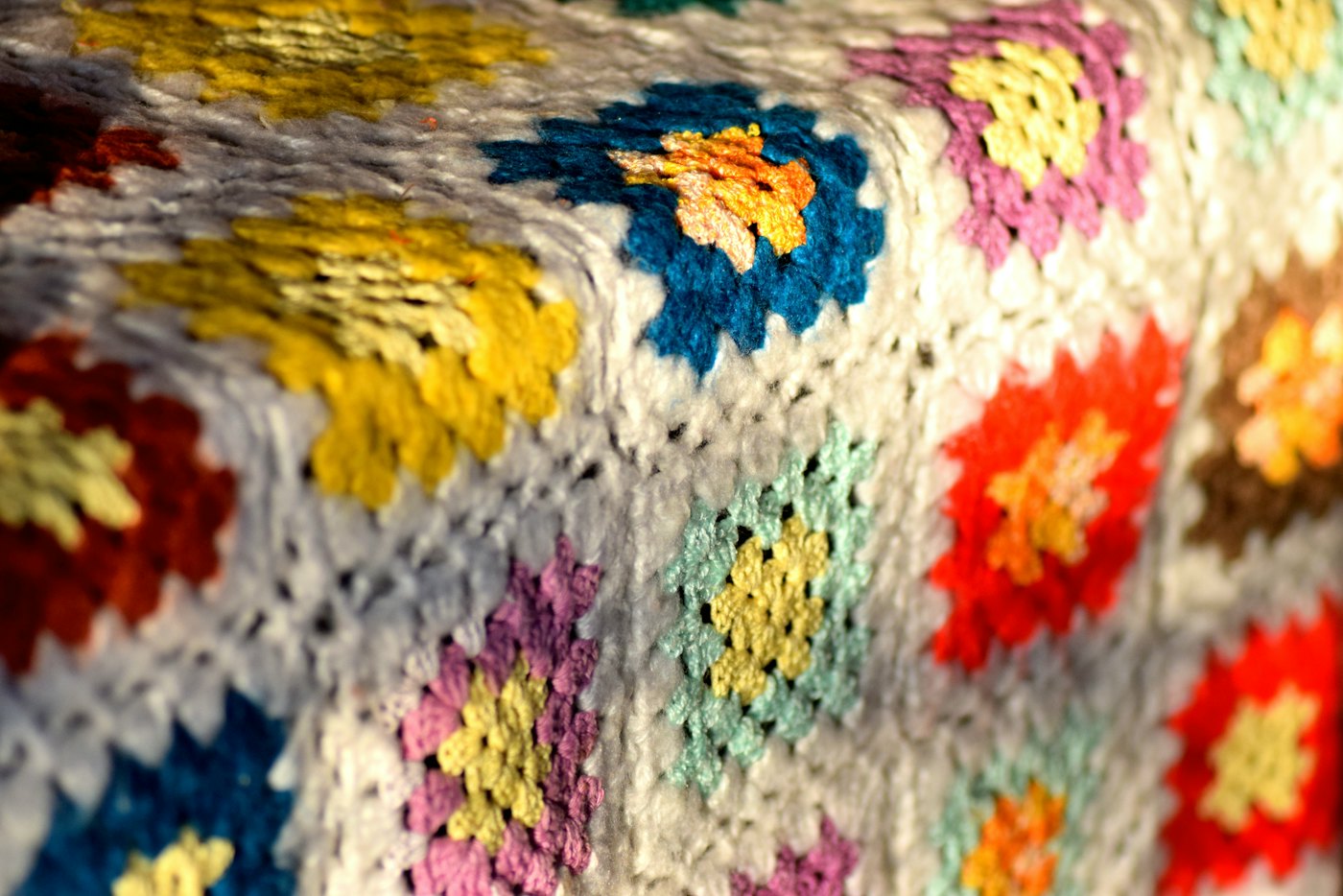
In granny squares you'll mostly work double crochets into chain spaces rather than into stitches. A pattern might say (3 dc, ch 2, 3 dc) in next ch-2 sp for a corner. That means work all of it into the gap made by the chain-2 below, not into the chains themselves.
When working in rounds, you usually chain 3 at the start of the round (counting as a dc) and join with a slip stitch to the top of that ch-3 at the end. Our granny square calculator shows how many squares and rounds you need for a given blanket size.
Common double crochet problems
- Stitches look short and lumpy: you may be pulling the first loop up too low. Let it come up to the height of the stitches around it.
- Fabric is too holey: your tension may be loose for this yarn. Try a hook half a millimeter smaller.
- Rows grow wider: you're probably working into the first stitch as well as using the ch-3 as a stitch. Skip the first stitch.
- Rows shrink: you're missing the top of the turning chain at the end of rows.
Questions crocheters ask
In most patterns, yes. Skip the first stitch and work the last stitch of the next row into the top of the ch-3. If your pattern says it doesn't count, work into the first stitch instead.
Related Crochet Calculators & Converters
Stitch Count Calculator
Calculate the exact number of stitches needed to resize any pattern or match custom dimensions.
Blanket Size Calculator
Standard blanket dimensions (Baby to King), estimated rows, stitches, and yardage requirements.
Granny Square Calculator
Calculate how many granny squares and joins you need to reach any finished blanket dimensions.
Related Educational Guides & Tutorials
Why Is My Crochet Blanket Getting Wider? 5 Causes and Fixes
A blanket that turns into a trapezoid is gaining stitches or changing tension. Diagnose which in two minutes, fix the five common causes, and rescue a blanket that's already wonky.
How to Fix Uneven Crochet Edges and Keep Them Straight
Almost every wobbly edge comes from the first and last stitch of each row. Learn the turning chain rules, the fixes for gappy edges, and how to tidy a finished piece with a border.