Yarn
How Much Yarn for a Crochet Blanket? Chart and 3 Ways to Estimate
A full yardage chart for every blanket size, what changes the numbers, and three ways to estimate, including a swatch method that's accurate to within a few percent.
8 min readPublished Updated
This profile is a development placeholder, not a real person, and claims no credentials. See our contributors.
The quick answer
For a standard throw (50 × 60 inches) in worsted-weight yarn and double crochet, plan on roughly 2,000 to 2,500 yards (about 1,800 to 2,300 meters). Our estimate is about 2,250 yards, right in the middle of the ranges commonly published by designers and yarn companies.
That's a starting point, not a promise. The real amount can swing by 20% or more depending on your stitch, your tension and your yarn. The rest of this guide gives you a full chart, explains what changes the numbers, and shows three ways to get an estimate you can trust, including one that's accurate to within a few percent.
Blanket yardage chart by size
These estimates are for double crochet, worked at a typical gauge for each yarn weight, without a border. Add extra for borders, fringe and safety (see below).
| Blanket | Size (in) | Size (cm) | DK (#3) | Worsted (#4) | Bulky (#5) |
|---|---|---|---|---|---|
| Lovey | 12 × 12 | 30 × 30 | 125 yd | 100 yd | 75 yd |
| Baby / stroller | 30 × 35 | 76 × 89 | 900 yd | 800 yd | 600 yd |
| Lapghan | 36 × 48 | 91 × 122 | 1,500 yd | 1,300 yd | 1,000 yd |
| Crib | 36 × 54 | 91 × 137 | 1,700 yd | 1,450 yd | 1,100 yd |
| Toddler | 42 × 52 | 107 × 132 | 1,900 yd | 1,650 yd | 1,250 yd |
| Throw | 50 × 60 | 127 × 152 | 2,600 yd | 2,250 yd | 1,700 yd |
| Twin | 66 × 90 | 168 × 229 | 5,150 yd | 4,450 yd | 3,400 yd |
| Full / double | 80 × 90 | 203 × 229 | 6,250 yd | 5,400 yd | 4,100 yd |
| Queen | 90 × 96 | 229 × 244 | 7,500 yd | 6,500 yd | 4,900 yd |
| King | 108 × 96 | 274 × 244 | 9,000 yd | 7,800 yd | 5,900 yd |
Blanket sizes aren't officially standardized, so you'll see slightly different dimensions from different sources. The bed sizes above cover a standard US mattress with a generous drop on each side. Our blanket size calculator lets you start from any of these sizes or enter your own.
What changes how much yarn you need
Your stitch
Dense stitches use much more yarn than open ones. Compared with double crochet:
| Stitch | Approximate yarn use |
|---|---|
| Single crochet | about 22% more |
| Half double crochet | about 8% more |
| Double crochet | baseline |
| Treble crochet | about 12% less |
| Granny clusters | about 8% less |
| Textured stitches (bobbles, puffs, waffle, post stitches) | 35% more, sometimes far more |
A throw in solid single crochet can easily need 2,700 yards where the same blanket in double crochet needs 2,250.
Your yarn weight
Finer yarn means more, smaller stitches to cover the same area, and so more yards. That's why the DK column above is always higher than the worsted one.
Your tension
A loose crocheter makes bigger stitches. Bigger stitches use more yarn each, but you need fewer of them; overall, looser fabric usually uses somewhat more yarn per square inch. If your gauge is looser than the pattern's, buy extra.
Borders, fringe and joining
A wide border can add 10% or more. Fringe uses a surprising amount: each tassel is several strands. Joining granny squares with a crocheted join also adds yardage on top of the squares themselves.
Method 1: estimate from the area
This is the method our calculators use. Multiply the blanket's area by a yards-per-square-inch figure for your yarn weight, then adjust for your stitch.
Yards = width × length × yards per square inch × stitch factor
Yards per square inch in double crochet:
| Yarn weight | Yards per sq in |
|---|---|
| #0 Lace | 2.2 |
| #1 Super fine | 1.6 |
| #2 Fine | 1.08 |
| #3 Light / DK | 0.87 |
| #4 Medium / worsted | 0.75 |
| #5 Bulky | 0.57 |
| #6 Super bulky | 0.48 |
| #7 Jumbo | 0.3 |
Example: a twin blanket (66 × 90 inches) in worsted half double crochet: 66 × 90 = 5,940 square inches. Then 5,940 × 0.75 × 1.08 = about 4,800 yards.
Where these numbers come from: we anchored worsted at 0.75 yards per square inch, which matches the commonly published 1,800–2,500 yards for a worsted throw. We then scaled the other weights by how many stitches fit in 4 inches according to the Craft Yarn Council's standard gauges. It's a sound estimate, but it can't know your hands, so treat it as a guide. The yarn calculator runs this formula for any size and stitch.
Method 2: the swatch method (most accurate)
If you want a number you can really rely on, measure your own yarn use. It takes one swatch and a kitchen scale.
- 1.Crochet a swatch in your blanket's stitch, yarn and hook, about 6 × 6 inches.
- 2.Measure its area. Width × height, for example 6 × 6 = 36 square inches.
- 3.Weigh it on a kitchen or postal scale, in grams.
- 4.Convert grams to yards using the yarn label. If the label says 200 yards per 100 g, that's 2 yards per gram.
- 5.Work out yards per square inch: yards in the swatch ÷ swatch area.
- 6.Multiply by your blanket's area.
Example: your 6 × 6 inch swatch weighs 13.5 g. With 2 yards per gram, that's 27 yards. 27 ÷ 36 = 0.75 yards per square inch. For a 50 × 60 inch throw, 3,000 square inches × 0.75 = 2,250 yards.
No scale? Unravel the swatch and measure the yarn directly with a tape measure. It's slower, but it works.
This method automatically accounts for your tension, your hook and your exact stitch pattern, which no chart can do.
Method 3: measure as you go
Already started? You can estimate from the blanket itself.
- 1.Weigh your remaining yarn (or count full balls), then crochet until your blanket measures a few inches, say 6 inches of length.
- 2.Weigh the yarn again. The difference is how much yarn those 6 inches took.
- 3.Divide your target length by the length you've worked, and multiply.
Example: 6 inches of a 60-inch blanket used 225 yards. 60 ÷ 6 = 10, so the whole blanket will take about 10 × 225 = 2,250 yards, plus the border.
This is especially useful when you're using up a mixed stash and don't know the exact yardage of each ball.
How much to actually buy
Once you have an estimate:
- Add 10–15% as a safety margin. It covers swatching, tension drift and the border. Running out two rows from the end is a famous crochet experience called yarn chicken, and the margin is how you avoid it.
- Buy all of it at once, from the same dye lot. The dye lot number is printed on the label. Different lots of the "same" color can differ enough to show as a stripe across your blanket.
- Buy by yardage, not weight. Two 100 g balls can hold very different lengths. Divide your total yards by the yards per ball on the label. Our skein calculator does this for you.
- Check the store's return policy. Many yarn shops accept unopened balls back, so buying an extra one costs little.
Example: 2,250 yards plus 15% is about 2,590 yards. With balls of 200 yards each, 2,590 ÷ 200 = 12.95, so buy 13 balls.
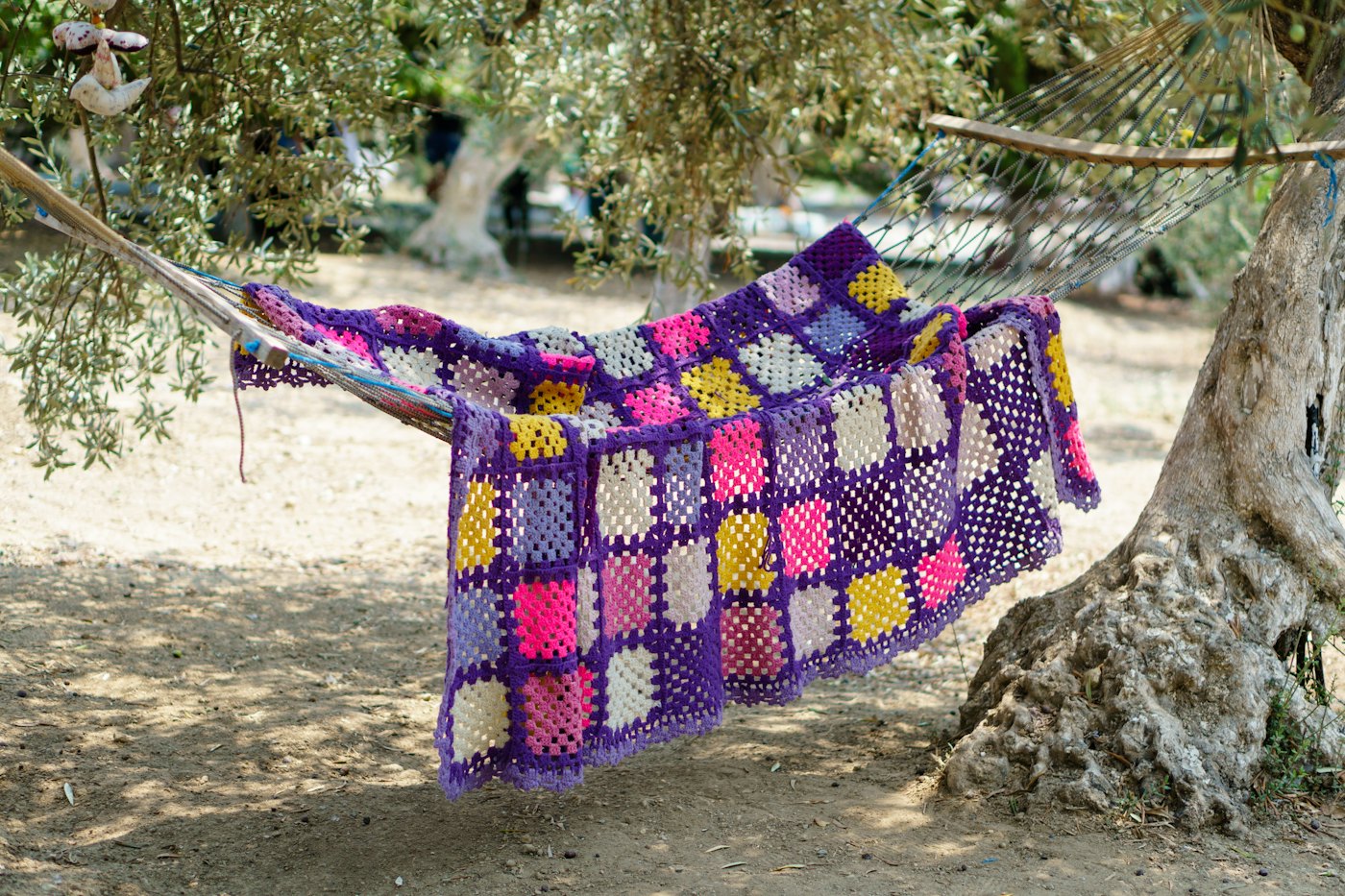
Granny square blankets
For blankets made of squares, it's easier to work square by square:
- 1.Make one complete square in your yarn and hook.
- 2.Weigh it, or unravel it and measure, to find the yards per square.
- 3.Work out how many squares you need. Our granny square calculator does this from your square size and blanket size.
- 4.Multiply yards per square by the number of squares.
- 5.Add yarn for joining (often 10–15% extra) and the border.
As a rough guide, a 6-inch granny square in worsted yarn takes about 25 yards. A 50 × 60 inch throw needs about 80 of them (around 8 × 10 squares), so roughly 2,000 yards for the squares, before joining and border. Weighing your own square is much more accurate than this rule of thumb.
Frequently asked questions
For a 50 × 60 inch throw in worsted yarn and double crochet, plan on about 2,000–2,500 yards. Divide by the yards per skein on your label: with 200-yard skeins, that's about 11–13 skeins, including a small safety margin.
Related Crochet Calculators & Converters
Yarn Calculator
Estimate total yardage, meters, and skein count needed for blankets, scarves, sweaters, and shawls.
Blanket Size Calculator
Standard blanket dimensions (Baby to King), estimated rows, stitches, and yardage requirements.
Granny Square Calculator
Calculate how many granny squares and joins you need to reach any finished blanket dimensions.
Skein Calculator
Calculate how many skeins or balls of yarn to buy based on yardage, grams, and ounces.
Related Educational Guides & Tutorials
What Is Crochet Gauge? How to Measure It and Why It Matters
Gauge is the translation key between the designer's hands and yours. Learn how to make a swatch that tells the truth, measure it, match the pattern, and use the math to size any project.
Yarn Weight Chart: Categories 0 to 7 Explained for Crochet
What yarn weight really means, the standard 0–7 chart with hooks and gauges, international ply names, how to identify unlabeled yarn, and how to substitute one yarn for another.
How to Fix Uneven Crochet Edges and Keep Them Straight
Almost every wobbly edge comes from the first and last stitch of each row. Learn the turning chain rules, the fixes for gappy edges, and how to tidy a finished piece with a border.