Crochet Hooks
Crochet Hook Sizes Chart: mm, US Letters and UK Sizes Explained
Why millimeters are the only size you can trust, a full conversion chart, steel hooks, which hook suits which yarn, and how hook shape and material change the way you crochet.
7 min readPublished Updated
This profile is a development placeholder, not a real person, and claims no credentials. See our contributors.
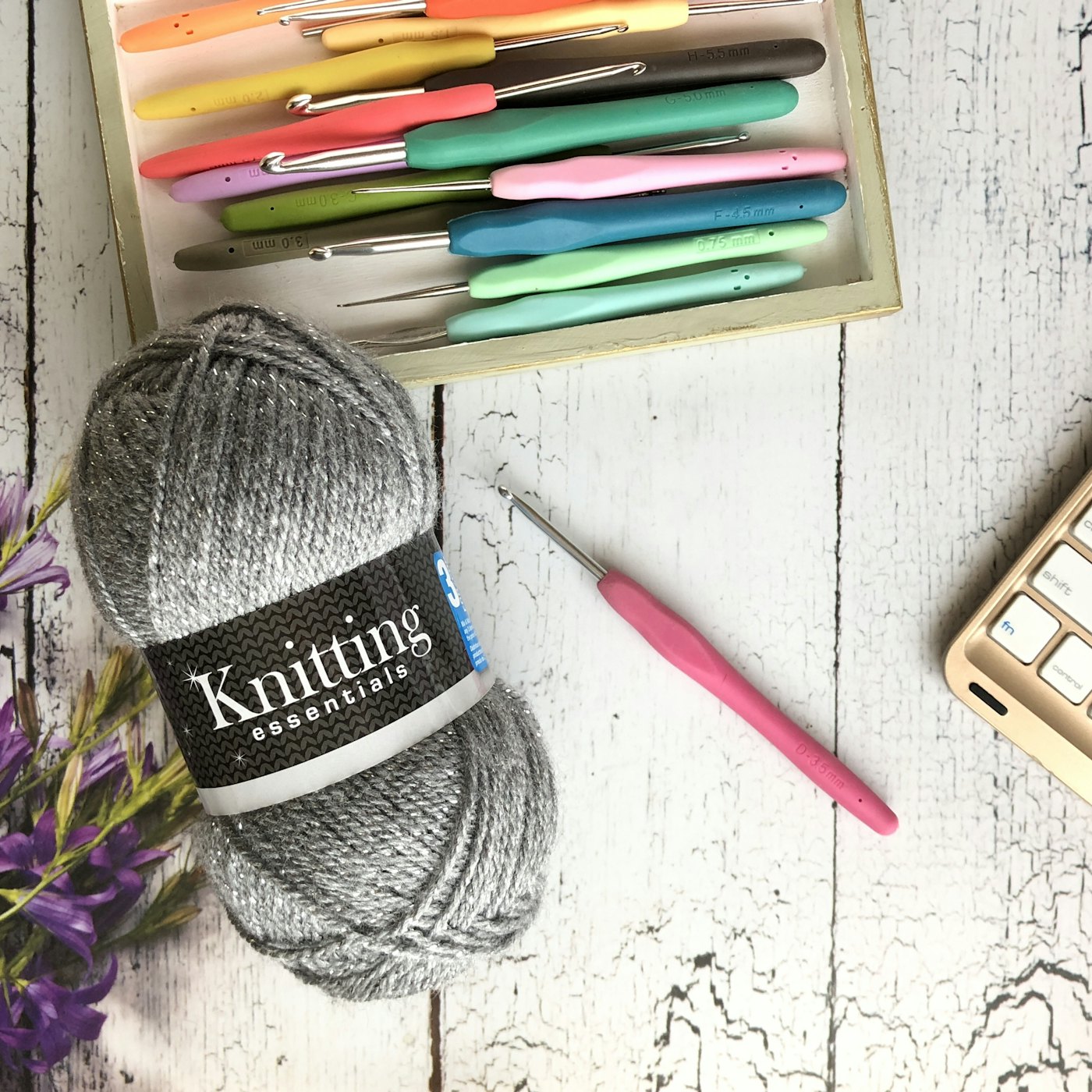
Always go by millimeters
Crochet hooks are labeled in up to three ways: a millimeter size (5 mm), a US letter and number (H-8), and sometimes an old UK number (6). Only one of these is precise and universal: the millimeter size.
The millimeter number is the diameter of the hook's shaft, the part that determines how big your loops are. US letters were assigned to those sizes, but brands haven't always agreed on them, and old UK numbers were never fully standardized. So whenever a pattern, a hook and a yarn label disagree, trust the millimeters.
Crochet hook size conversion chart
This chart follows the Craft Yarn Council's standard hook sizes for US letters. Old UK numbers are shown where commonly published charts agree.
| Millimeters | US size | Old UK size |
|---|---|---|
| 2.25 mm | B-1 | 13 |
| 2.75 mm | C-2 | varies (often 12) |
| 3.0 mm | – | 11 |
| 3.25 mm | D-3 | 10 |
| 3.5 mm | E-4 | varies (often 9) |
| 3.75 mm | F-5 | varies (often 9) |
| 4.0 mm | G-6 | 8 |
| 4.5 mm | 7 | varies (often 7) |
| 5.0 mm | H-8 | 6 |
| 5.5 mm | I-9 | 5 |
| 6.0 mm | J-10 | 4 |
| 6.5 mm | K-10½ | 3 |
| 7.0 mm | – | 2 |
| 8.0 mm | L-11 | 0 |
| 9.0 mm | M/N-13 | 00 |
| 10.0 mm | N/P-15 | 000 |
| 11.5 mm | P-16 | – |
| 15 mm | P/Q | – |
| 16 mm | Q | – |
| 19 mm | S | – |
| 25 mm | T/U/X | – |
Why some UK sizes say "varies": published conversion charts disagree about UK sizes 12, 9 and 7. For example, some list UK 12 as 2.5 mm and others as 2.75 mm. Old UK hooks weren't made to one standard, so if you're following a vintage UK pattern, use the closest millimeter hook and check your gauge.
Our hook size converter lets you look up any size in all three systems.
The confusing sizes: G, I and J
Some US letters have been used for two slightly different hooks:
| Letter | Standard size | Older or brand-specific size |
|---|---|---|
| G | G-6 = 4.0 mm | G = 4.25 mm |
| I | I-9 = 5.5 mm | I = 5.25 mm |
| J | J-10 = 6.0 mm | J = 5.75 mm |
The Craft Yarn Council's chart lists both versions. A quarter of a millimeter sounds tiny, but it can change your gauge. If a pattern says "size G" without a millimeter size, look for the millimeters in the materials list or the designer's notes.
Steel hooks for thread and lace
Very fine crochet, such as doilies, lace edgings and work in crochet thread, uses steel hooks, which are much smaller than regular hooks. They use their own numbering system, and it runs backwards: the higher the number, the smaller the hook.
According to the Craft Yarn Council, steel hooks run from about #14 (0.9 mm), the smallest, up to #00 (2.7 mm). The CYC recommends steel hooks around sizes 6, 7 and 8 for lace-weight yarn and fine thread.
Steel is used for these sizes because a hook that thin made of aluminum or wood would bend or snap. If you're new to thread crochet, start with a mid-size steel hook and a thicker thread, such as size 10, before moving to finer work.
Which hook for which yarn?
The Craft Yarn Council's recommended hook ranges for each yarn weight are a good starting point:
| Yarn weight | Common names | Recommended hook |
|---|---|---|
| #0 Lace | Fingering 10-count, crochet thread | Steel 1.4–1.6 mm, or regular 2.25 mm |
| #1 Super fine | Sock, fingering, baby | 2.25–3.5 mm (B-1 to E-4) |
| #2 Fine | Sport, baby | 3.5–4.5 mm (E-4 to 7) |
| #3 Light | DK, light worsted | 4.5–5.5 mm (7 to I-9) |
| #4 Medium | Worsted, afghan, aran | 5.5–6.5 mm (I-9 to K-10½) |
| #5 Bulky | Chunky, craft, rug | 6.5–9 mm (K-10½ to M/N-13) |
| #6 Super bulky | Super bulky, roving | 9–15 mm (M/N-13 to Q) |
| #7 Jumbo | Jumbo, roving | 15 mm and larger (Q and up) |
These are guidelines, not rules, and the CYC itself describes them that way. In practice:
- Many crocheters use a 5 mm (H-8) hook with worsted yarn, a little smaller than the official range, for a firmer fabric. That's normal.
- Amigurumi is usually made with a hook one or two sizes smaller than the yarn label suggests, so the fabric is tight enough to hide the stuffing.
- Lace and drapey shawls are often made with a larger hook for open, flowing fabric.
- Always follow your pattern's gauge when size matters, and choose whichever hook gets you there.
Parts of a crochet hook
Knowing the parts makes it easier to choose hooks and to understand tension advice:
- Point (tip): the end that goes into the stitch. Sharper points slide into tight stitches more easily; rounder points are less likely to split yarn.
- Throat: the groove that catches the yarn and holds it as you pull through.
- Shaft: the straight part just below the throat. Its diameter is the hook's size, and your loops should sit here, not on the narrower throat.
- Thumb rest (grip): a flattened area where your fingers hold the hook. It's usually printed with the size.
- Handle: the rest of the hook, which rests in your hand.
Inline and tapered hooks
Hooks come in two main head shapes. Inline hooks have a throat cut straight into the shaft, so the head is in line with it. Tapered hooks have a rounder head that sticks out a little past the throat. Neither is better, but they feel different, and many crocheters strongly prefer one. If one brand feels awkward, try the other style before deciding crochet isn't for you.
Hook materials compared
| Material | Feels like | Good for |
|---|---|---|
| Aluminum | Smooth and fast; yarn glides | Most yarns, especially wool and acrylic; affordable |
| Steel | Very strong, very thin | Thread and lace work |
| Bamboo and wood | Warm, light, a little grippy | Slippery yarns like silk and bamboo; some people find them gentler on the hands |
| Plastic | Light, warm | Large and jumbo sizes, where metal would be heavy |
| Ergonomic (soft handle) | Thick cushioned handle | Long sessions, arthritis or hand pain |
Remember that switching materials mid-project can change your gauge. Yarn glides on aluminum and grips on bamboo, so your stitches may come out slightly different sizes even with the same millimeter hook.
Special hooks you might come across
- Tunisian (afghan) hooks are long, sometimes with a flexible cable, because Tunisian crochet holds a whole row of loops on the hook at once.
- Double-ended hooks have a hook at each end, used for some Tunisian techniques and for working in the round with two colors.
- Jumbo hooks (15 mm and up) are used with very thick yarn and roving for chunky blankets and rugs.
- Light-up hooks have an LED in the handle, helpful for dark yarns or crocheting in dim light.
For everyday crochet, a set of standard aluminum hooks from 3.5 mm to 6.5 mm covers most patterns, and you can add specialty hooks when a project needs them.
Frequently asked questions
A 5 mm (H-8) or 5.5 mm (I-9) hook with smooth, light-colored worsted-weight yarn. The stitches are big enough to see clearly and the hook is comfortable to hold.
Related Crochet Calculators & Converters
Crochet Gauge Calculator
Calculate stitch density and precise rows and stitches needed for your target project dimensions.
Crochet Hook Size Converter
Convert between US letter/number sizes, UK vintage numbers, and precise metric millimeter hook sizes.
Yarn Weight Converter
Compare Craft Yarn Council categories (0 to 7), WPI, ply equivalents (US/UK/AUS), and hook pairings.
Related Educational Guides & Tutorials
What Is Crochet Gauge? How to Measure It and Why It Matters
Gauge is the translation key between the designer's hands and yours. Learn how to make a swatch that tells the truth, measure it, match the pattern, and use the math to size any project.
Yarn Weight Chart: Categories 0 to 7 Explained for Crochet
What yarn weight really means, the standard 0–7 chart with hooks and gauges, international ply names, how to identify unlabeled yarn, and how to substitute one yarn for another.
US vs UK Crochet Terms: Conversion Chart and How to Tell Them Apart
A UK double crochet is a US single crochet. Here's the full conversion chart, why the systems differ, how to spot which one a pattern uses, and how to convert without mistakes.